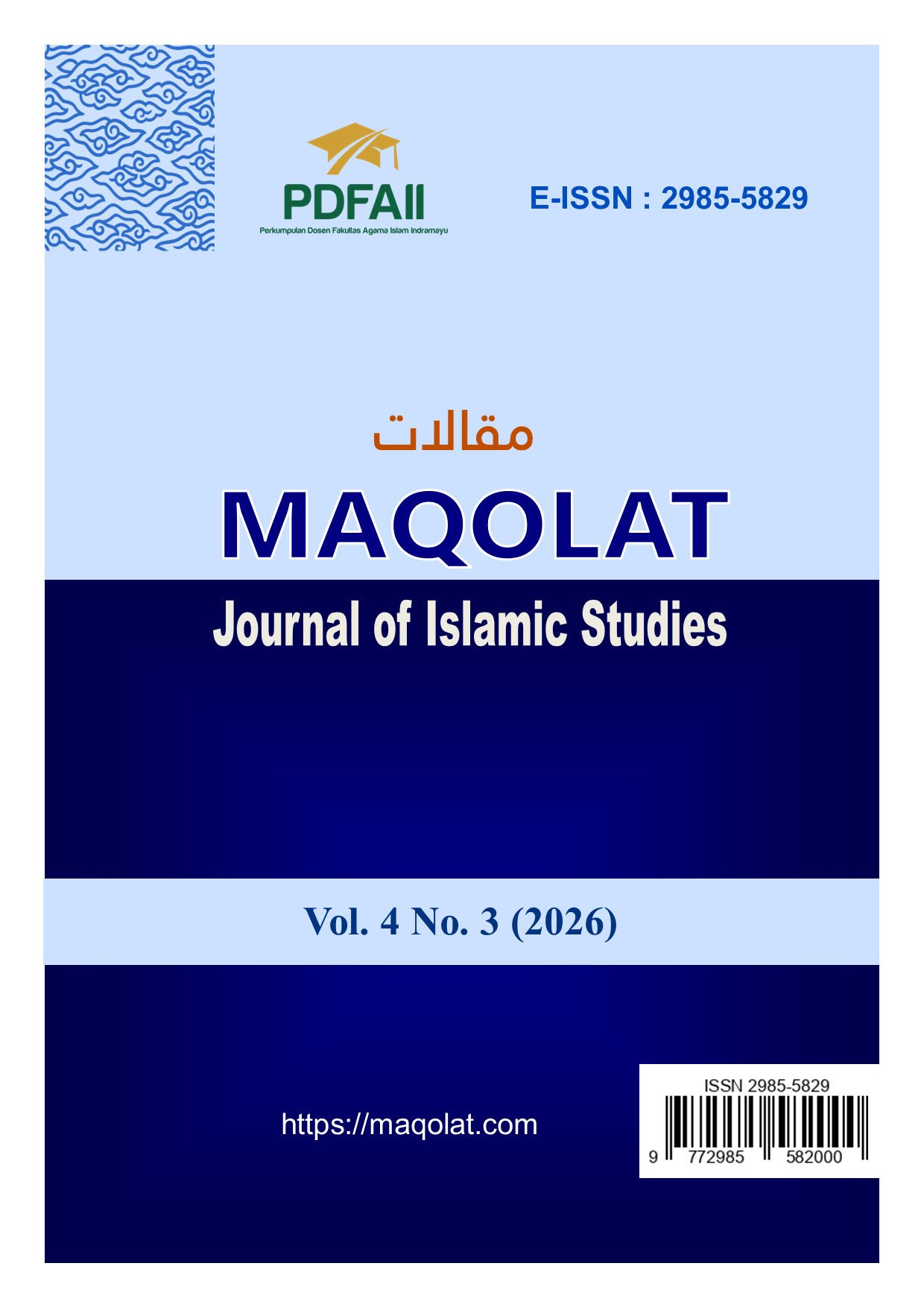
Active Patience In Qur'anic War Verses: Ibn Kathir's Perspective And Its Relevance To Palestinian Sumud
DOI:
https://doi.org/10.58355/maqolat.v4i3.248Keywords:
Active Patience, Ibn Kathir, War Verses, Sumud, PalestineAbstract
This study aims to reconstruct the concept of active patience in Ibn Kathir's interpretation of Q. al-Baqarah [2]:249, Q. Āli ‘Imrān [3]:120 and 125, and Q. al-Anfāl [8]:46 and 65–66, and then assess its conceptual relevance to Palestinian sumud during the post-7 October 2023 Gaza war. This qualitative library research employs exegete-centered thematic exegesis, using the Maktabah Dār al-Salām edition of Tafsīr al-Qur’ān al-‘Aẓīm as primary data and Palestine–Gaza literature, particularly publications from 2021–2026, as secondary data. The analysis involves contextual verification, extraction of meaning units, thematic coding, cross-verse synthesis, and critical comparison. The findings identify six dimensions of active patience: faith orientation and appraisal, self-control, spiritual obedience, directed action, group cohesion, and capacity-sensitive adaptation. The model shows that patience supports moral and coordinative readiness rather than functioning as a mechanical formula for victory. Active patience intersects with sumud in steadfastness, agency, religiosity, solidarity, and continuity of life, but the two are not identical. Their relevance is conceptual, not causal, and does not justify generalizing civilian data to armed actors.
Downloads
References
Abbas, Bassam Yacoub, and Hussein Ali Bahr. “Al-Aqsa Flood Operation: Harbingers and Geopolitical Repercussions.” Qadaya Siyasiyyah, no. 76 (2024): 367–96.
Abudayya, Abdallah. “Voices from Gaza: Coping Strategies During the War on the Gaza Strip—A Qualitative Study.” Mental Health & Prevention 39 (2025): 200443. https://doi.org/10.1016/j.mhp.2025.200443.
Abuward, Ola H., C. Fiscone, N. M. Abulibda, A. Mustafa, and G. Veronese. “Do You Think All of Us Are Mentally Sick Because of This Horror? Mental Health under Genocide in Gaza.” International Journal of Human Rights in Healthcare 18, no. 4 (2025). Based on the abstract. https://doi.org/10.1108/IJHRH-10-2024-0073.
Agbaria, Qutaiba, and Amnah Abu Mokh. “Coping with Stress During the COVID-19 Outbreak: The Contribution of Self-Control Skills and Religiosity in Arab Israeli-Palestinian Students in Israel.” Journal of Religion and Health 62 (2023): 720–38. https://doi.org/10.1007/s10943-022-01686-3.
Agbaria, Qutaiba, and Amnah Jameel Abu-Mokh. “The Use of Religious and Personal Resources in Coping with Stress during COVID-19 for Palestinians.” Current Psychology 42 (2023): 12866–78. https://doi.org/10.1007/s12144-021-02669-5.
Aidini, Nur, and Nur Luthfi Hidayatullah. “Sekuritisasi Hamas dalam Kebijakan Israel Pasca Serangan 7 Oktober 2023.” Journal Politique 5, no. 1 (2025): 21–35. https://doi.org/10.15642/politique.2025.5.1.21-35.
Alfain, Shinta Nuriya Idatul, Achmad Khudori Soleh, and Muhammad Rafi Yamani. “The Role of Patience in Coping Mental Problems: A Quranic Perspective.” Tribakti: Jurnal Pemikiran Keislaman 34, no. 2 (2023): 195–206. https://doi.org/10.33367/tribakti.v34i2.3633.
Aliffizriah, Diana, Oyoh Bariah, and M. Makbul. “Nilai-Nilai Pendidikan Islam pada Perang Badar dalam Al-Qur’an Surah Ali Imran Ayat 123–126 Tafsir Ibnu Katsir.” INNOVATIVE: Journal of Social Science Research 4, no. 4 (2024): 5780–94.
Amrulloh, Muhamad, and Sucila Ningsih. “Makna Lafazh Al-Bala’ dalam Al-Qur’an: Telaah Kitab Tafsir Al-Mishbah.” Al Karima: Jurnal Studi Ilmu Al Quran dan Tafsir 6, no. 1 (2022): 38–53. https://doi.org/10.58438/alkarima.v6i1.116.
Aqtam, Ibrahim. “A Narrative Review of Mental Health and Psychosocial Impact of the War in Gaza.” Eastern Mediterranean Health Journal 31, no. 2 (2025): 89–96. https://doi.org/10.26719/2025.31.2.89.
Awayed-Bishara, Muzna. “Sumud Pedagogy as Linguistic Citizenship: Palestinian Youth in Israel against Imposed Subjectivities.” Language in Society 54, no. 1 (2025): 5–27. https://doi.org/10.1017/S0047404523000891.
Baidan, Nashruddin, and Erwati Aziz. Metodologi Khusus Penelitian Tafsir. Yogyakarta: Pustaka Pelajar, 2016.
Braun, Virginia, and Victoria Clarke. “Conceptual and Design Thinking for Thematic Analysis.” Qualitative Psychology 9, no. 1 (2022). Based on the abstract. https://doi.org/10.1037/qup0000196.
Busse, Jan. “Everyday Life in the Face of Conflict: Sumud as a Spatial Quotidian Practice in Palestine.” Journal of International Relations and Development 25 (2022). Based on the abstract. https://doi.org/10.1057/s41268-022-00255-1.
Faizin, F. A. Amirul, Arif Firdausi N.R., and Edy Wirastho. “Makna Khusyu’ dalam Al-Qur’an: Studi Kajian Tematik dalam Perspektif Tafsir Al-Azhar.” Al Furqan: Jurnal Ilmu Al Quran dan Tafsir 7, no. 1 (2024): 37–55. https://doi.org/10.58518/alfurqon.v7i1.2524.
Fekih-Romdhane, Feten, Mai Helmy, Amthal Alhuwailah, Hanaa Ahmed Mohamed Shuwiekh, Emna Maalej, Abdallah Y. Naser, Sahar Obeid, Alexandre Andrade Loch, Majda Cheour, and Souheil Hallit. “Resilience and Religiosity as Moderators between War-Related Media Exposure and Psychotic Experiences in the Aftermath of the October 2023 Israel-Gaza War.” Discover Public Health 22 (2025): 213. https://doi.org/10.1186/s12982-025-00599-2.
Hadi, Sopyan. “Konsep Sabar dalam Al-Qur’an.” Jurnal Madani: Ilmu Pengetahuan, Teknologi, dan Humaniora 1, no. 2 (2018): 473–88.
Hamamra, Bilal, and Fayez Mahamid. “Faith, Community, and Resilience during Genocide in Gaza.” Disasters 50, no. 1 (2026): e70023. Based on the abstract. https://doi.org/10.1111/disa.70023.
Hamamra, Bilal, Fayez Mahamid, Dana Bdier, and Mai Atiya. “War-Related Trauma in Narratives of Gazans: Challenges, Difficulties and Survival Coping.” Cambridge Prisms: Global Mental Health 12 (2025): e34. https://doi.org/10.1017/gmh.2025.23.
Hamid, Muhibussabri. “Konstruksi Pemikiran Politik Syekh Ahmad Yasin di Palestina: Perspektif Alexander Wendt.” FATHIR: Jurnal Studi Islam 2, no. 3 (2025): 345–56. https://doi.org/10.71153/fathir.v2i3.328.
Ibnu Katsir, Ismā‘īl ibn ‘Umar. Tafsīr al-Qur’ān al-‘Aẓīm. Edited by Sāmī ibn Muḥammad al-Salāmah. 8 vols. Riyadh: Dār Ṭayyibah, 1999 CE/1420 AH. Digital edition, Internet Archive. https://archive.org/details/tafsir-ibn-kathir.
Ibnu Katsir, Ismā‘īl ibn ‘Umar. Tafsīr al-Qur’ān al-‘Aẓīm. Vols. 1–2. Damascus: Maktabah Dār al-Salām, 1992 CE/1413 AH.
Kumalasari, Silva. “Makna Sabar dalam Tafsir Fi Zhilal Al-Qur’an.” Al Karima: Jurnal Studi Ilmu Al Quran dan Tafsir 4, no. 2 (2020): 79–88. https://doi.org/10.58438/alkarima.v4i2.58.
Mahamid, Fayez A., and Dana Bdier. “The Association Between Positive Religious Coping, Perceived Stress, and Depressive Symptoms During the Spread of Coronavirus (COVID-19) Among a Sample of Adults in Palestine: A Cross-Sectional Study.” Journal of Religion and Health 60 (2021): 34–49. https://doi.org/10.1007/s10943-020-01121-5.
Majid, Abdul, and Andri Nirwana AN. “Study of Ibnu Katsir’s Tafsir on the Values of Patience in QS Al-Anfal: 65, Ar-Ra‘du: 22, and An-Nahl: 42.” Al-Afkar: Journal for Islamic Studies 7, no. 2 (2024): 376–84. https://doi.org/10.31943/afkarjournal.v7i2.952.
Marzūq, ‘Abd al-Ṣabūr. Mu‘jam al-A‘lām wa al-Mauḍū‘āt fī al-Qur’ān al-Karīm. 3 vols. Cairo: Dār al-Syurūq, 1995 CE/1415 AH.
Murtadho, Azam Jabir, Arif Firdausi N.R., and Edy Wirastho. “Penafsiran Ayat tentang Bullying dalam Al-Qur’an: Studi Komparasi Tafsir Al-Azhar dan Tafsir Al-Mishbah.” El-Wasathy 2, no. 1 (2024): 182–96. https://doi.org/10.61693/elwasathy.vol21.2024.182-196.
Mustaqim, Abdul. Metode Penelitian Al-Qur’an dan Tafsir. Yogyakarta: Idea Press, 2014.
Rahmawati, Lilis. “Konsep Sabar dalam Perspektif Ulama Tafsir.” Al-Hikmah: Jurnal Theosofi dan Peradaban Islam 5, no. 2 (2023): 182–200.
Sari, Ayu Novita. “Reevaluasi Kajian Metode Tafsir Tematik (Mustafa Muslim dalam Karyanya Mabahits fi Tafsir Maudhu‘i).” At-Tahfidz: Jurnal Ilmu Al-Qur’an dan Tafsir 3, no. 2 (2022): 47–61.
Shofia, Naila. “Komparasi Sabar dan Optimis dalam Tinjauan Kitab Tafsir Ibnu Katsir dan Psikologi.” Master’s thesis, UIN Maulana Malik Ibrahim Malang, 2024.
Taher, Tamara. “Practicing Wujud: A Constellation of Sumud in the Fragmented Palestinian Present.” Middle East Critique 33, no. 2 (2024). Based on the abstract. https://doi.org/10.1080/19436149.2024.2330815.
Ulum, Khoirul, and Ahmad Khoirur Roziqin. “Sabar dalam Al-Qur’an: Kajian Tafsir Maudhu‘i.” Jurnal Ilmu Al-Qur’an dan Hadis 4, no. 1 (2021): 120–42.
Van Teeffelen, Toine, and Fuad Giacaman. “The Concept of Sumud, Resistance and Citizenship in Occupied Palestine: Critical Pedagogy and Muslim-Christian Living Together.” Journal of Holy Land and Palestine Studies 24, no. 2 (2025): 159–79. https://doi.org/10.3366/hlps.2025.0361.
Zabidi, Ahmad, Hamnah, and Maulana. “Interpretasi Sabar dalam Al-Qur’an: Studi Komparatif Al-Qurthubi dan Ibnu Katsir.” Borneo: Journal of Islamic Studies 4, no. 1 (2023): 33–45.
Downloads
Published
How to Cite
Issue
Section
License
Copyright (c) 2026 Restu Mareta Nur Agung, Muhamad Amrulloh, Edy Wirastho

This work is licensed under a Creative Commons Attribution 4.0 International License.